For many long-established general practices, patient demand hasn’t slowed. But staffing, time, and attention are finite.
This New Zealand general practice has been serving its community for over 40 years. Like many high-volume clinics, it prides itself on warm, family-centred care. Yet found itself increasingly stretched by call volume, peak-hour pressure, and after-hours overflow.
Patients were calling repeatedly just to get through.
Staff were pulled away from in-person care to manage ringing phones.
And despite best efforts, the clinic had limited visibility into why patients were calling or where the biggest pressure points really were.
This case study shows what happened when the clinic introduced Heron as a support layer for its front desk — not to replace people, but to give them room to breathe.
Access the case study: https://pitch.com/v/case-study-anonymized-8z4tek
The Challenge: High Demand, Limited Bandwidth
Before Heron, the clinic faced challenges familiar to many practices:
High call volumes during peak hours
Frequent interruptions to clinical and administrative work
Missed calls and after-hours gaps
Repetitive administrative requests consuming staff time
Patient frustration reflected in negative phone-related reviews
The team needed help… but not at the cost of the human touch their patients expected.
Why Heron
The clinic chose Heron for a simple reason: it is built for healthcare realities.
Heron integrated directly with the clinic’s phone system, handled both business-hours and after-hours inquiries, and escalated safely when a human was needed. Most importantly, it strengthened the front desk instead of competing with it.
No complex PMS integration.
No workflow overhaul.
Just immediate relief where pressure was highest.
What Changed
Over a high-volume month, Heron quietly absorbed a substantial share of patient communication: answering calls, handling chats, capturing intent, and summarising interactions for staff follow-up.
The results were tangible:
Over 1,100 patient interactions managed
93% patient acceptance of AI-handled calls
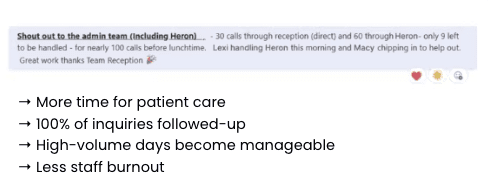
Nearly 20 hours of staff time offloaded
Consistent handling of after-hours calls
Clear visibility into the clinic’s most common inquiry types
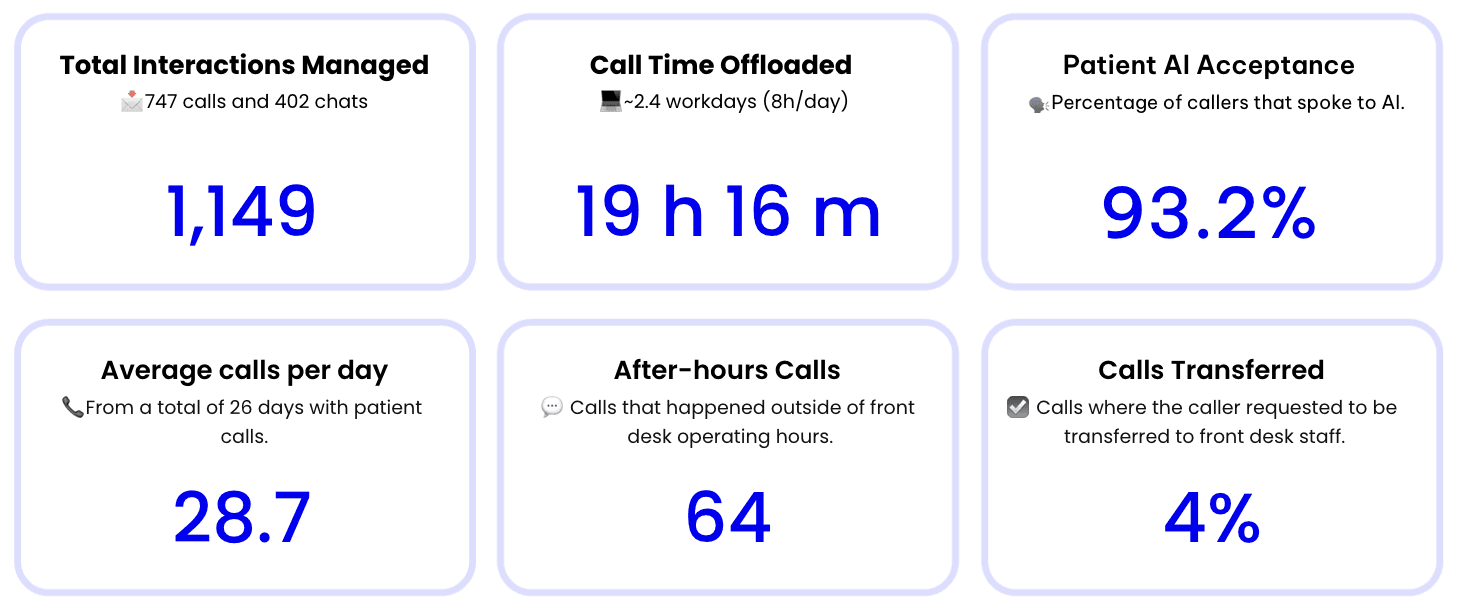
Behind the numbers was a more important shift: the front desk felt calmer.
Staff reported fewer disruptions, clearer follow-ups, and high-volume mornings that no longer felt overwhelming (even on days with close to 100 calls before lunchtime).
The Patient Experience
Patients noticed the difference too.
Instead of waiting on hold or calling back repeatedly, they received immediate answers for routine needs like appointments, prescriptions, and general questions. More complex issues were escalated safely to staff.
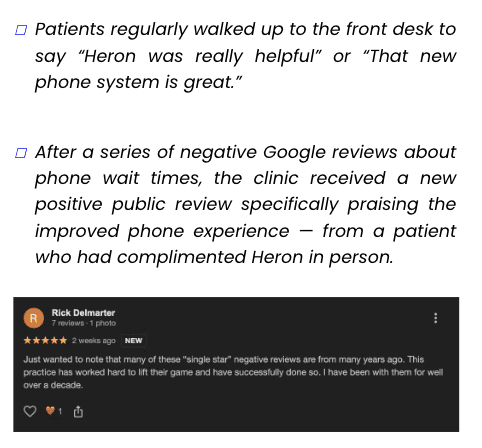
Several patients went out of their way to compliment the new phone experience; including one who followed up in person after leaving a positive public review specifically praising the improvement.
More Time to Care
Today, Heron acts as a dependable support layer for the clinic, stepping in whenever lines are busy or calls are missed, and giving staff back the space to focus on patients in front of them.
The outcome isn’t just efficiency. It’s a front desk that feels human again.
That’s what this case study captures: not just what AI can automate, but what it can give back: time, calm, and better care at scale.