A patient calls your clinic. The phone rings out. They call back later, get through, and spend two minutes explaining what they need — in Mandarin — to a receptionist who's doing their best but doesn't speak the language fluently.
That patient hangs up feeling unheard. Your receptionist hangs up feeling ineffective. And somewhere in the handoff, the message gets lost.
For GP clinics serving linguistically diverse communities, this isn't an edge case. It's a daily reality. And for smaller practices with lean admin teams, the solution can't simply be "hire more multilingual staff."
This post looks at how one Auckland general practice, supporting over 3,600 patients with a small team, found a practical way to close that gap. Not by replacing their staff, but by giving them a better system to work with.
What you'll learn:
Why multilingual patient communication is a structural problem, not just a staffing one
The specific challenges this small Auckland clinic was navigating
What Heron provided, and how it was set up
Four months of real data: call volume, patient acceptance, staff impact, and inquiry breakdown
The Problem Is Bigger Than the Phone Queue
When people talk about communication pressure in GP clinics, the conversation usually centres on call volume. But for clinics serving multicultural communities, there's a second layer: the quality and clarity of those calls, not just the quantity.
This Auckland clinic serves patients in both English and Mandarin. Like many clinics in New Zealand's larger cities, a meaningful portion of their patient population is more comfortable, and more accurately understood, in their first language.
The challenge isn't that staff don't care. They do. The challenge is structural: a small admin team can't realistically provide consistent bilingual coverage across all hours, all inquiry types, and all peak periods. Something gives.
What was giving, specifically
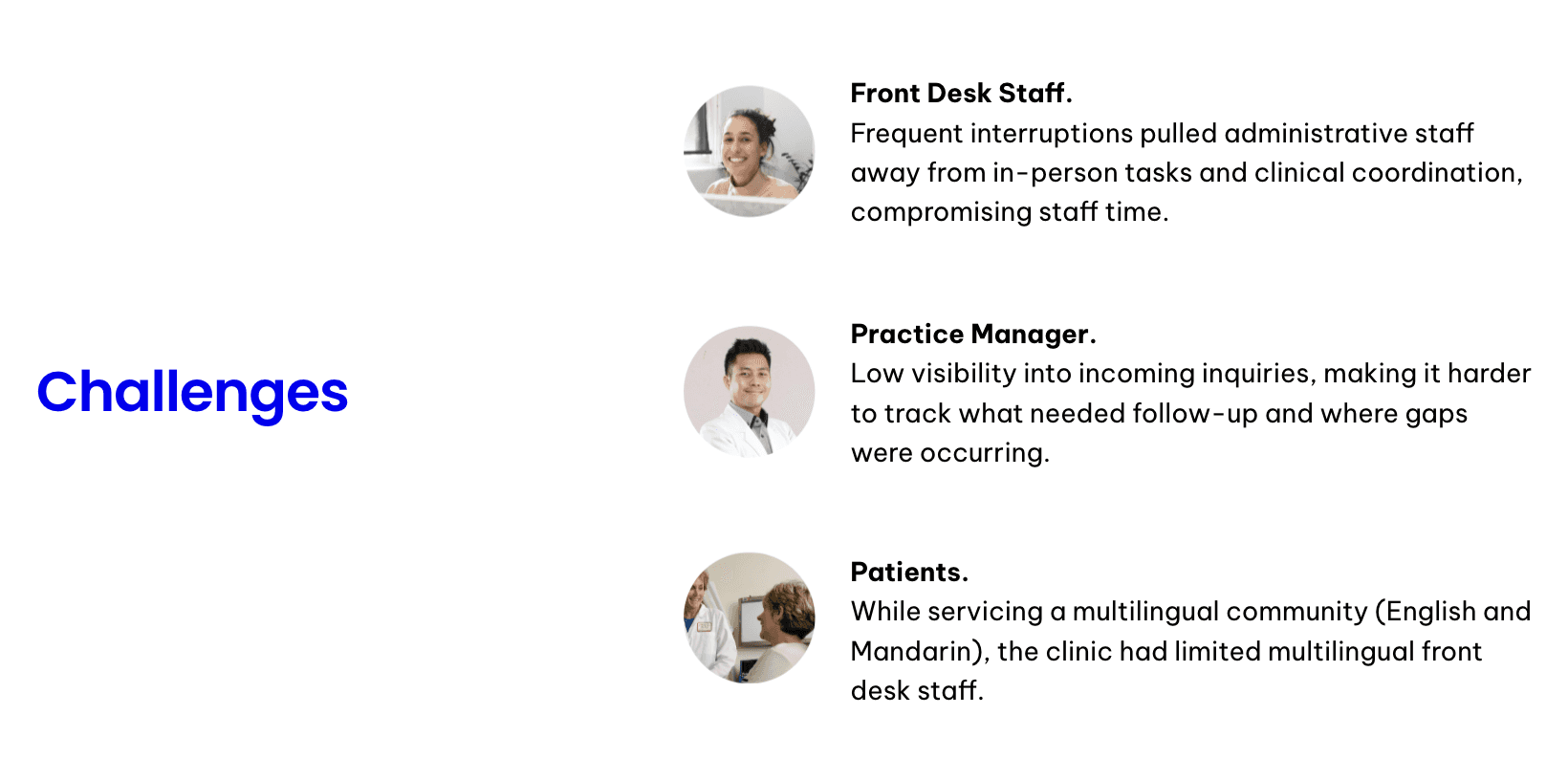
The clinic was running into three compounding problems.
Front desk interruptions. Administrative staff were being pulled away from in-person work and clinical coordination to handle calls. Each interruption cost time and focus, and with a small team, there's very little slack to absorb it.
Low visibility. The practice manager had limited insight into what types of inquiries were coming in, which were being resolved, and where patients were falling through the cracks. Without that data, it was difficult to identify patterns or make informed decisions about how to staff or triage.
Language gaps at the front desk. When Mandarin-speaking patients called, the clinic had limited capacity to respond fluently. This affected not just the patient experience, but the accuracy of information exchanged, which matters in a healthcare setting.
What the Clinic Actually Needed
It's worth being specific about what the right solution looks like for a clinic of this size.
A large practice might solve this by hiring an additional bilingual receptionist. A small practice with 3,600 enrolled patients and a lean team doesn't have that budget or that headcount margin. What they need is a way to handle the routine — the appointments, prescriptions, general questions, and after-hours calls — without that work falling entirely on a small group of people.
They also need the system to work accurately. In healthcare, a misunderstood message isn't just frustrating. It can mean a patient misses an appointment, delays a prescription refill, or doesn't get triaged correctly.
How Heron Was Set Up
The clinic introduced Heron as a front-line communications layer across three functions.
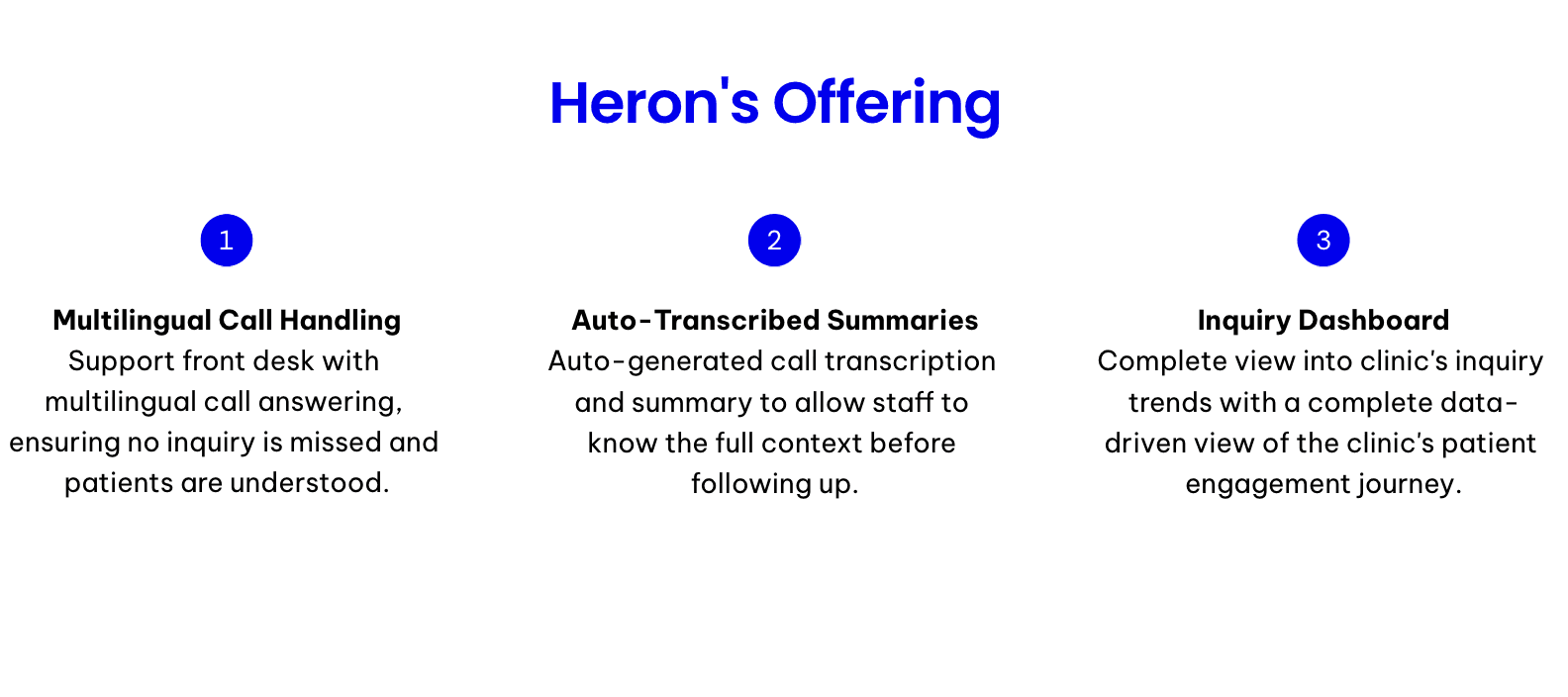
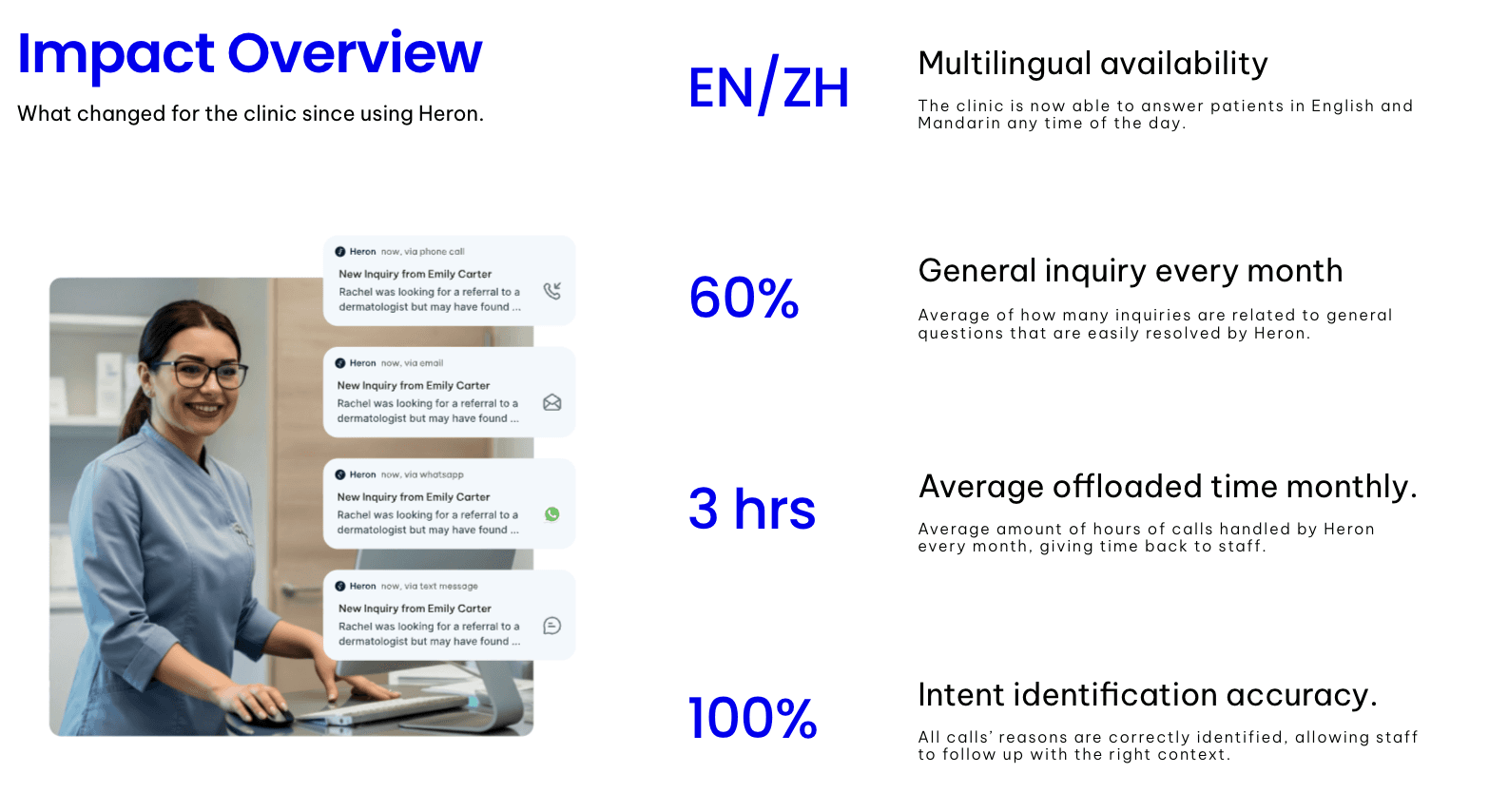
Multilingual call handling. Heron handles inbound patient calls in both English and Mandarin — responding accurately to the patient in their preferred language, capturing the reason for the call, and either resolving the inquiry or escalating to staff with full context.
Auto-transcribed call summaries. Every interaction handled by Heron is transcribed and summarised, so when staff follow up, they already know exactly what the patient needed. No repeated explanations. No information lost in translation.
Inquiry dashboard. The practice manager gained a structured view of inquiry trends: what patients were calling about, how often, and whether each inquiry was resolved. For the first time, the clinic had data to make decisions with.
Four Months of Data: What It Showed
Looking at one high-volume month of operation in detail, alongside the trend across four months, tells a consistent story.
Metric | Result |
|---|---|
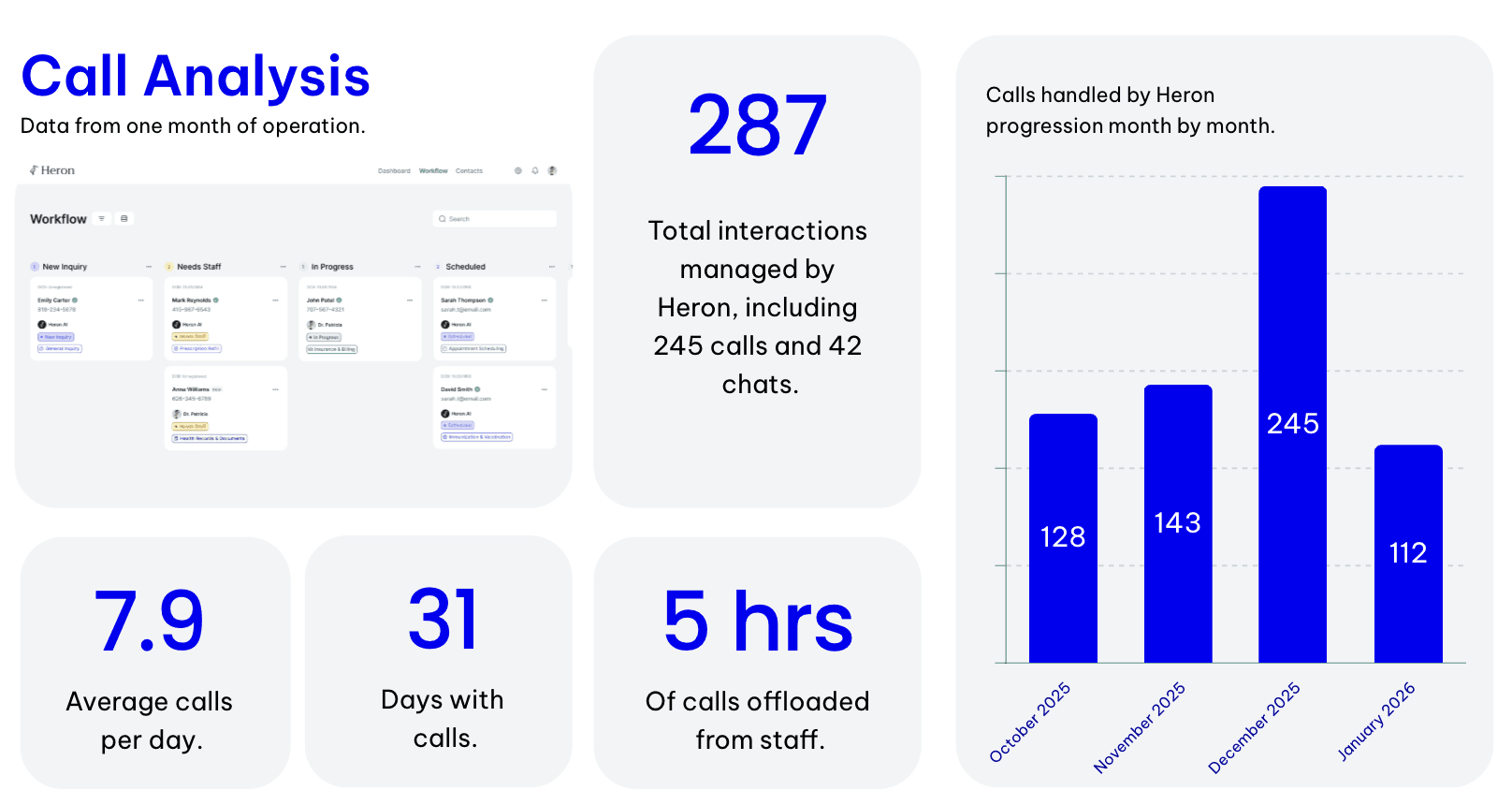
Total interactions managed by Heron | 287 (245 calls + 42 chats) |
Average calls per day | 7.9 |
Days with call activity | 31 |
Call time offloaded from staff | 5 hours |
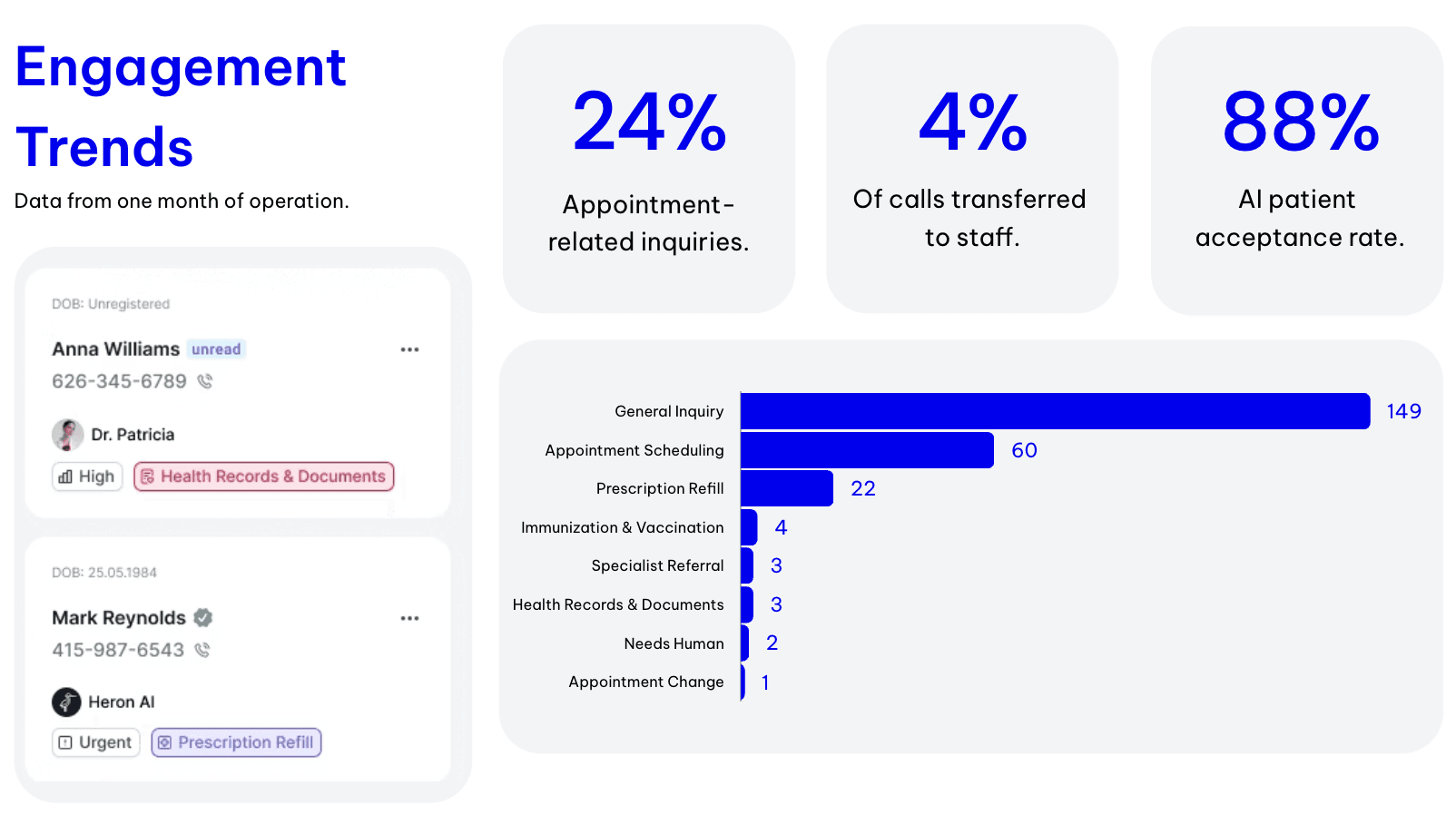
Patient acceptance rate | 88% |
Calls transferred to staff | 4% |
Intent identification accuracy | 100% |
General inquiries resolved by Heron | ~60% monthly average |
The growth trend across months was also notable. Heron handled 128 interactions in October, 143 in November, 245 in December, and 112 in January; with December representing the busiest period, typically the hardest time of year for a small clinic team to absorb extra demand.
What patients were actually calling about
The breakdown of inquiry types revealed something useful for the practice manager:
General inquiries: 149
Appointment scheduling: 60
Prescription refills: 22
Immunisation and vaccination: 4
Specialist referrals: 3
Health records and documents: 3
Needs human: 2
Appointment changes: 1
Around 60% of all monthly inquiries fell into the "general inquiry" category: questions that are routine, answerable, and don't require clinical judgment. These are exactly the interactions that were previously interrupting staff and consuming front desk time.
The 4% transfer rate is equally telling. Only 4 in every 100 calls needed to be escalated to a human. The rest were resolved entirely through Heron; with 100% intent accuracy, meaning staff always had the full picture when following up.
The Multilingual Dimension: Why It Matters
The patient acceptance rate of 88% is meaningful on its own. But for a clinic serving a multilingual community, it carries additional weight.
Patients choosing to continue with Heron, including Mandarin-speaking patients, rather than hanging up or calling back indicates that the interaction felt usable and clear. Not just technically functional, but actually helpful in the moment.
This matters for equity as much as efficiency. When a patient can communicate in their first language and receive an accurate, contextualised response, that's a materially better healthcare experience than being misunderstood or deferred.
For a small clinic, providing that consistently without dedicated multilingual staffing would have been impossible before. With Heron as a support layer, it became the default.
What Staff Said
Staff reported two direct changes to their working day.
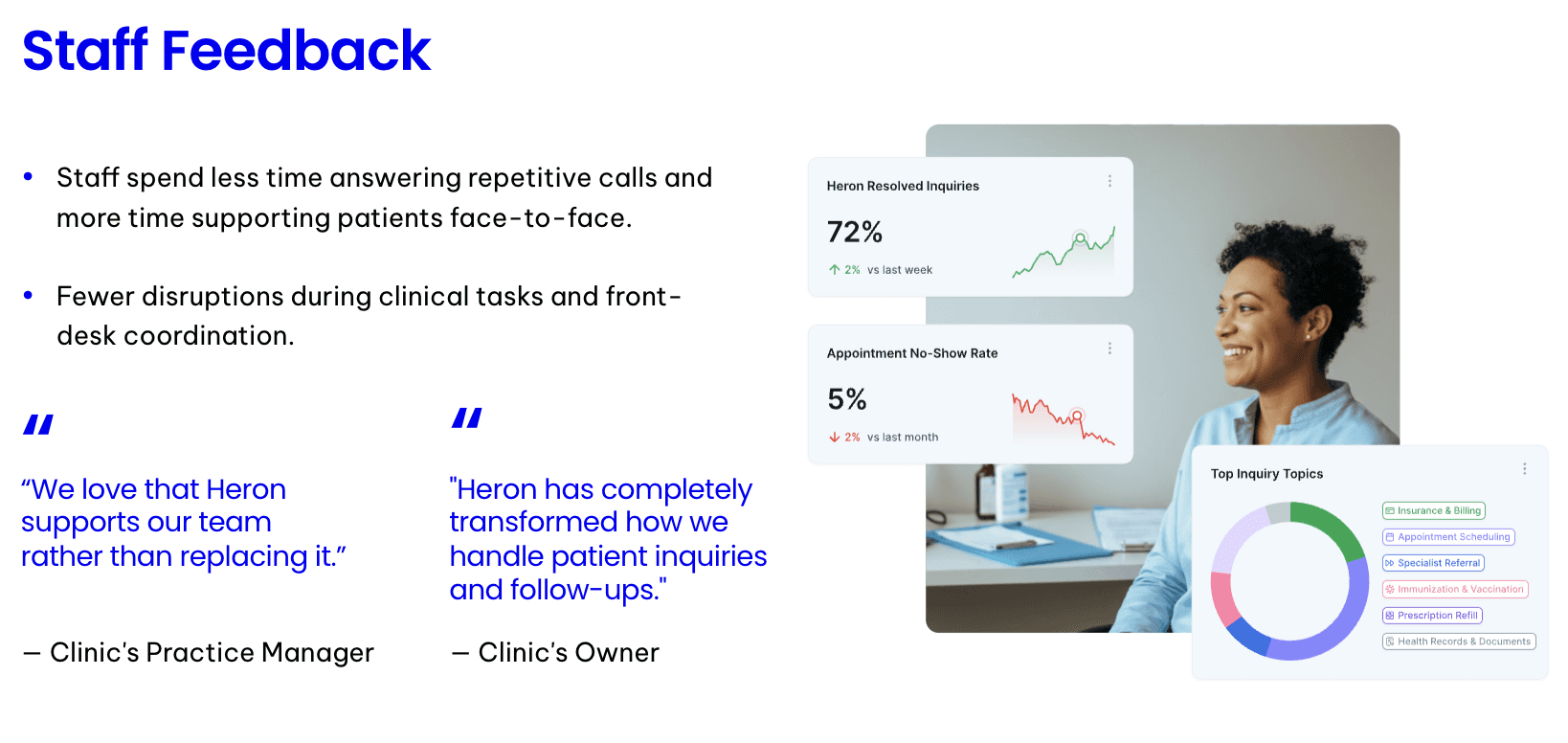
The first was fewer interruptions during clinical tasks and coordination work — less context-switching, more sustained focus. The second was more time with patients face-to-face, which is where a small practice team has the most impact.
The practice manager and clinic owner both described the shift in the same terms: Heron supports the team rather than replacing it.
"We love that Heron supports our team rather than replacing it." — Practice Manager
"Heron has completely transformed how we handle patient inquiries and follow-ups." — Clinic Owner
These aren't abstract endorsements. They reflect a specific operational change: staff are no longer the single point of contact for every patient inquiry, across every language, at every hour of the day.
What This Looks Like in Practice
For a small clinic serving a diverse community, the gains from Heron aren't just about efficiency metrics. They're about sustainability.
A small team that's constantly interrupted, covering language gaps with limited resources, and operating without visibility into inquiry patterns will eventually hit a ceiling, in staff capacity, in patient experience, and in the quality of care they can deliver.
What this clinic found is that the ceiling isn't fixed. It moves when you have the right support system in place.
Book a Free Demo to see how Heron works for GP clinics like yours.
Frequently Asked Questions
Can Heron actually handle patient calls in Mandarin accurately?
Yes. Heron's multilingual call handling supports both English, Mandarin, and any languages necessary for clinics, responding to patients in their preferred language and capturing inquiry details accurately. In this clinic's case, 88% of patients, including Mandarin-speaking callers, engaged with and completed their interaction through Heron without needing to be transferred.
Is Heron suitable for a small clinic with a lean admin team?
It's particularly well-suited to smaller practices. Heron handles the high volume of routine, repeatable inquiries — general questions, appointment scheduling, prescription refills — that consume the most admin time, freeing a small team to focus on coordination and face-to-face care.
What happens when a patient needs to speak to a human?
Heron identifies when an inquiry requires human judgment and escalates accordingly, passing the call to staff with a full transcript and summary of the interaction. In this clinic, only 4% of calls required transfer to staff.
Does Heron work after hours?
Yes. After-hours call handling is a core function. For this clinic, Heron provided consistent coverage during evenings and weekends, periods where a small team would otherwise have no coverage at all.
How quickly does the inquiry dashboard give useful data?
From the first week of operation. The dashboard shows inquiry types, volumes, and resolution rates in real time, giving practice managers a clear view of communication patterns that previously had no visibility at all.